

As administrative demands grow, medical practices often face staff overload, delays, higher costs, and less time for patient care. A medical virtual assistant can help manage many of these tasks remotely, but choosing the right fit requires careful evaluation.
In this guide, My Mountain Mover answers critical questions about choosing a medical virtual assistant, including what they do, what operational benefits this role can support, and what the Health Insurance Portability and Accountability Act (HIPAA) compliance requires from this arrangement. Understanding these factors can help your practice evaluate how to build a secure, efficient remote staffing model with the right safeguards, onboarding, and oversight.
Choosing a medical virtual assistant starts with identifying where the administrative workload creates the most operational strain:
A medical virtual assistant is a trained administrative professional who remotely supports healthcare practice operations through approved digital systems, including electronic health records, scheduling software, communication platforms, and practice management systems. Depending on the arrangement, they may also support insurance, billing, and referral workflows.
A medical virtual assistant does not replace a licensed medical professional or provide clinical care, such as diagnosing patients or prescribing medication. Instead, they manage administrative processes that help practices maintain operational continuity before, during, or after patient encounters.
For example, a medical virtual assistant may confirm appointments before a patient arrives, update administrative information after a visit, or follow up on an outstanding insurance request. In this way, remote medical administrative support can complement an existing healthcare team.
The specific duties should be documented before the relationship starts. Clear responsibilities help prevent role confusion and support appropriate system access.
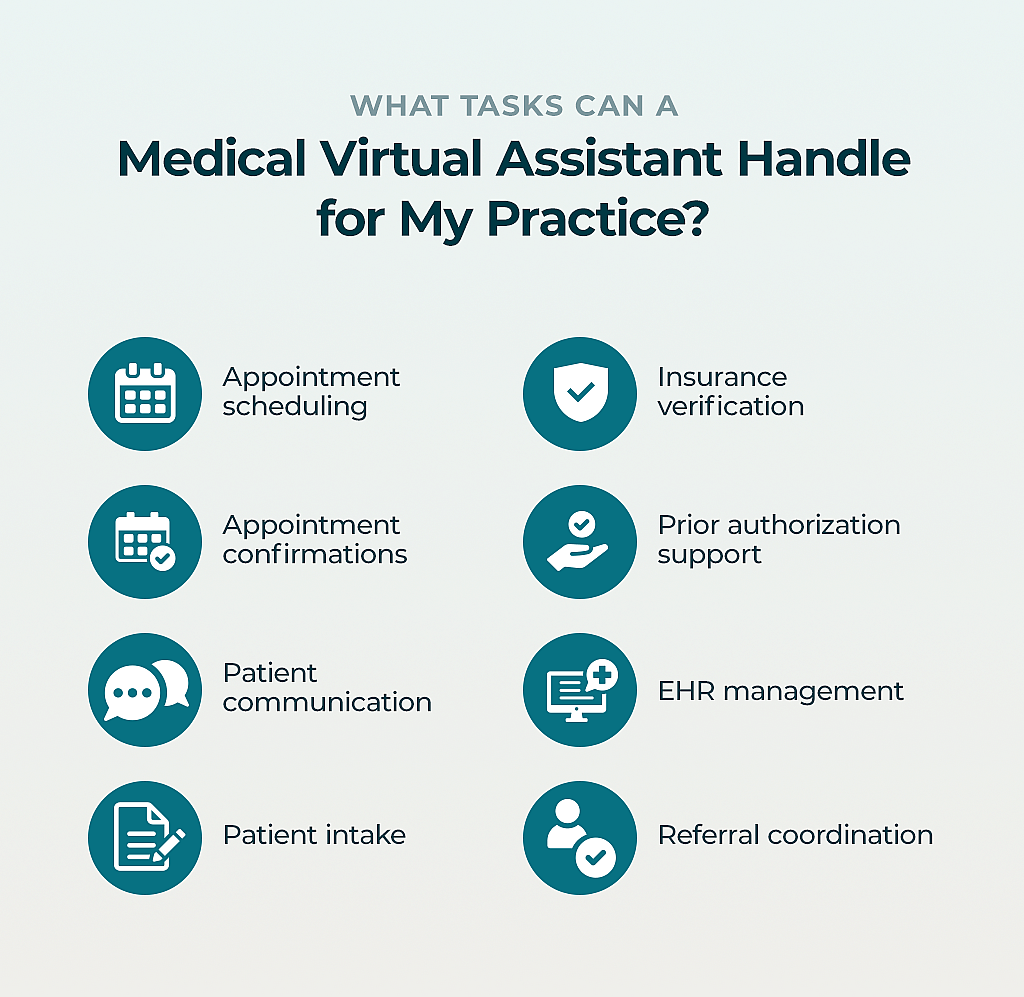
Physicians and their staff can spend about 13 hours a week on prior authorizations alone. A medical virtual assistant steps in to support these administrative processes across the patient journey. The specific workload depends on the practice, specialty, technology, and staffing model. Common tasks include:
Practices can define which responsibilities the medical virtual assistant will take on. They should also establish escalation procedures for tasks that need further clinical judgment.
A medical virtual assistant can support more than task completion by helping practices redistribute eligible administrative work across providers, on-site staff, and remote professionals. For many practices, this model can reduce administrative pressure, improve staffing flexibility, and expand access to specialized administrative skills.
Reduced Administrative Overhead
Administrative work can take up substantial time across a medical practice. The medical virtual assistant can manage scheduling requests, documentation tasks, patient messages, and billing follow-up, all of which accumulate quickly. Clinical staff then have more time for patient-facing work.
This arrangement can also reduce interruptions. Providers and medical assistants do not need to address every routine administrative request themselves. For practices experiencing documentation backlogs or delayed callbacks, this redistribution can improve workflow consistency. The goal here is not to remove administrative work, but to assign each task to the appropriate team member.
Lower Staffing Costs
Traditional hiring involves more than an employee’s salary, because practices also need to account for benefits, payroll expenses, office space, equipment, and other overhead. A remote staffing model can reduce some of those physical workplace costs.
The total financial impact varies by provider, workload, and staffing arrangement. Practices should compare the full cost of each model rather than hourly rates alone. Costs should also be evaluated against performance. A lower-cost medical virtual assistant may not provide value if training requirements, turnover, or quality issues create additional work.
Access to a Broader Talent Pool
Approximately 314,400 annual staff openings are projected across the broader secretary and administrative assistant category. These are driven primarily by retirement and role transfers rather than net new positions, reflecting ongoing replacement demand rather than supply growth.
Because local recruitment limits practices to candidates within a reasonable commuting distance, remote staffing can expand the available talent pool and help practices find professionals with healthcare administrative experience who may be difficult to source locally. A broader recruitment pool can also provide access to workers familiar with specific EHRs, scheduling platforms, and revenue cycle processes.
Experience still requires verification. Practices should assess healthcare knowledge, communication skills, technology proficiency, and reliability before making any hiring decisions.
Scalable Administrative Capacity
As a practice grows, new providers, additional patients, and expanded services can increase scheduling, billing, and communication workloads. A medical virtual assistant can add administrative capacity without requiring the practice to immediately expand its physical footprint.
The model can also support practices with fluctuating administrative requirements. Responsibilities can be reviewed and adjusted as workloads change. Scalability should remain structured. Additional responsibilities need appropriate training, supervision, and system permissions.
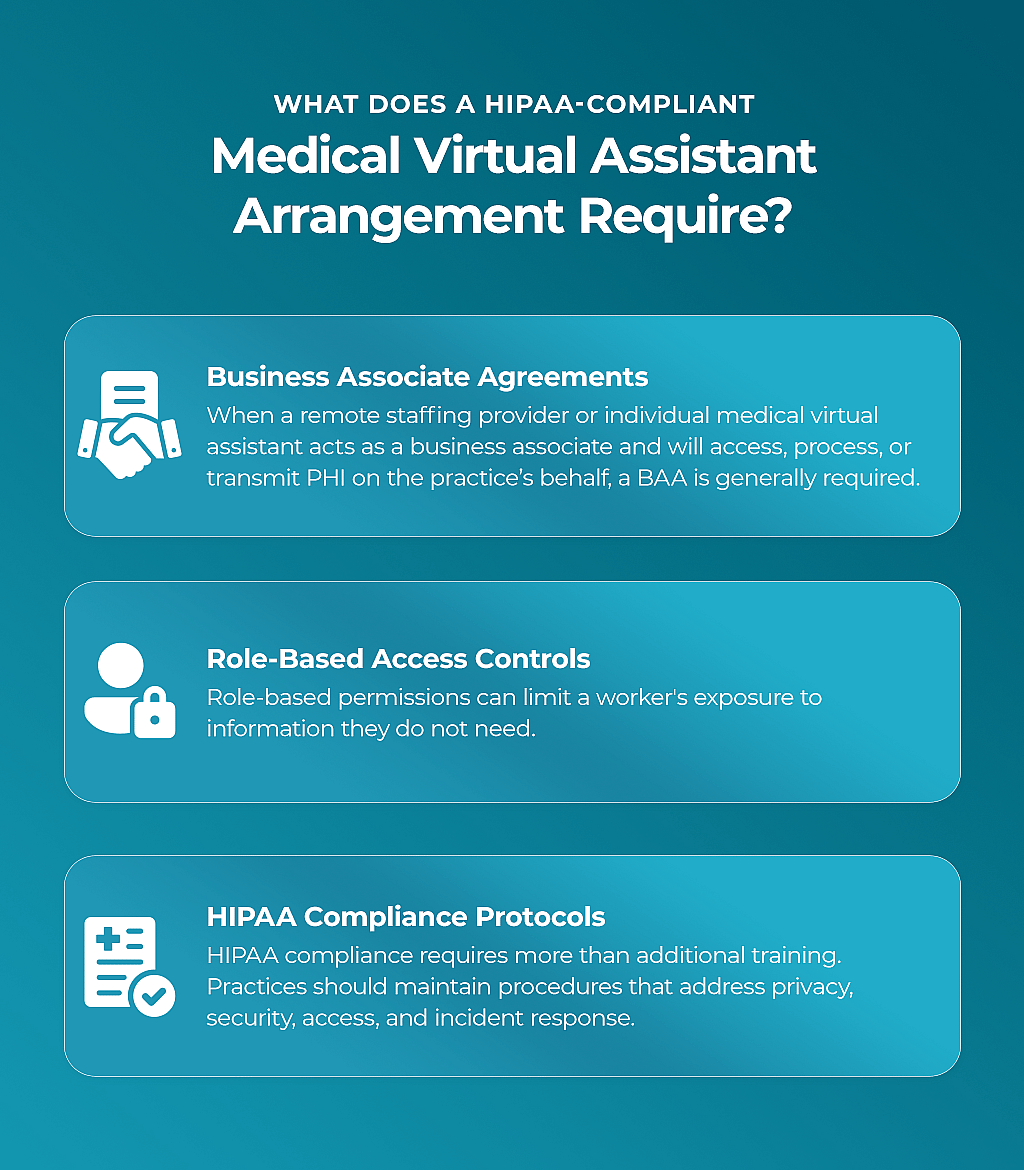
HIPAA requirements still apply when administrative work happens outside the practice, so remote professionals who access protected health information need appropriate safeguards and clearly defined responsibilities. Before granting system access, practices should evaluate the relationship, technology, and information involved.
Business Associate Agreements
A business associate agreement (BAA) may be needed when a medical virtual assistant or staffing company performs certain services involving protected health information on behalf of a covered entity. When a remote staffing provider or individual medical virtual assistant acts as a business associate and will access, process, or transmit protected health information (PHI) on the practice’s behalf, a BAA is generally required. This agreement establishes permitted uses and disclosures of PHI while outlining responsibilities for safeguards, reporting, and other applicable requirements
Practices should determine whether their specific arrangement requires a BAA. They should also verify that the agreement reflects how the virtual assistant will handle information. Operating without a BAA in place constitutes a HIPAA violation, regardless of whether a data breach occurs. The absence of the agreement itself constitutes noncompliance.
Role-Based Access Controls
Medical virtual assistants should have access based on their assigned responsibilities. Role-based permissions can limit a worker’s exposure to information they do not need. Access should also be reviewed when these responsibilities change.
Secure authentication provides another layer of protection. Practices should use appropriate credentials and authentication controls for healthcare systems. Remote workers should follow documented procedures for passwords, authentication, and device security. Access should be removed promptly when it is no longer necessary.
HIPAA Compliance Protocols
HIPAA compliance requires more than additional training. Practices should maintain procedures that address privacy, security, access, and incident response. Medical virtual assistants should understand how these procedures apply to their responsibilities. Training should cover the appropriate handling of protected PHI and the approved communication method.
Practices should document relevant training and acknowledgments. They should also maintain access records, conduct policy reviews and engage in other compliance activities. Regular reviews can identify changes in responsibilities or security requirements. These reviews help ensure the remote staffing arrangement continues to align with the practice’s compliance program.
Before selecting a medical virtual assistant provider, ask questions that address both operations and HIPAA compliance. These questions can help identify providers with structured processes. They can also expose potential gaps before the medical virtual assistant receives access to sensitive systems:
The best medical virtual assistant is one with skills that closely match your practice’s workload. Use these criteria to find the right fit:
The right staffing model depends on the practice’s responsibilities, patient volume, and administrative needs. These questions address common considerations when evaluating a medical virtual assistant:
What is the difference between a medical virtual assistant and a medical assistant?
A medical virtual assistant primarily performs administrative work remotely. Their scope is strictly non-clinical: scheduling, billing coordination, insurance verification, EHR documentation, and patient communication. A medical assistant typically works on-site, supporting both administrative and clinical workflows. The two roles are distinct in licensure, function, and setting, and should not be used interchangeably.
Can a medical virtual assistant support specialty-specific administrative workflows?
Yes, medical virtual assistants support administrative functions across a wide range of specialties, including primary care, behavioral health, allied health, cardiology, orthopedics, and others. While their scope remains non-clinical, many remote administrative professionals have experience with the scheduling patterns, insurance workflows, and documentation conventions specific to particular practice types, which reduces the orientation period when they begin working within a new practice environment.
Why is a full-time medical virtual assistant more effective than a part-time arrangement?
A full-time engagement allows time to develop familiarity with a practice’s specific systems, workflows, communication preferences, and operational rhythms. A part-time or shared arrangement in which the assistant divides attention among multiple clients limits the depth of that integration. With the right onboarding and oversight, full-time, dedicated support can help promote more consistent task completion, fewer errors, and stronger alignment with how the practice operates day-to-day.
What does onboarding a medical virtual assistant typically involve?
Onboarding a medical virtual assistant starts with defining responsibilities, workflows, and performance expectations. System access should match the assistant’s assigned duties. Training should address HIPAA requirements, privacy procedures, and security practices. A thorough onboarding process can influence how quickly and effectively the assistant integrates into the practice’s day-to-day operations.
Choosing a medical virtual assistant starts with understanding where the administrative workload most affects your practice. The goal of this remote hire is to reduce pressure on clinical staff while adding flexible administrative capacity. It can also expand access to healthcare administrative talent beyond the local hiring market.
When choosing the right medical virtual assistant, keep HIPAA compliance at the core of practice requirements. Practices should also address BAAs, access controls, training, security, and documentation before work begins. As healthcare organizations face growing administrative demands, remote staffing is becoming a more practical component of modern practice operations.
This story was produced by My Mountain Mover and reviewed and distributed by Stacker.