

Utility costs are often cited as a major source of financial stress for homeowners already struggling to balance their mortgage, maintenance and property tax costs. But is it burdening some homeowners more than others?
For this article, Hometap analyzed data from doxo's 2025 Utilities Insights Report and the U.S. Energy Information Administration to break down average monthly utility costs across all 50 states and identify the factors that most affect what homeowners pay.
Utility costs are one of the most variable and most often underestimated expenses in homeownership. Monthly bills for electricity, gas, water and other services can differ by hundreds of dollars depending on where a home is located, how large it is, and how it's built.
Understanding average utility costs and the factors that drive them can help homeowners budget more accurately and spot when their bills are running higher than they should.
Utilities are the essential services that keep a home functional and comfortable, and they make up a significant share of monthly homeownership costs. According to the doxo report, the average American household pays $489 per month for utilities, or $5,868 annually.
That figure varies dramatically depending on a range of factors, from climate to home age to household habits.
Utilities typically refer to six primary services:
Average utility costs vary significantly depending on which of these services a home requires and how much of each is used.
Home Size and Type
A home's square footage directly affects its utility consumption. A 1,000-square-foot apartment requires far less energy to heat and cool than a 3,000-square-foot single-family home. According to residential energy consumption data from the U.S. Energy Information Administration, larger homes typically use 50% to 75% more electricity and gas than smaller residences.
Home type also matters. Single-family homes generally have higher utility costs than townhomes or condominiums, which benefit from shared walls that provide natural insulation. Apartments often have the lowest utility costs due to their compact size and shared building infrastructure.
Geographic Location and Climate
Regional climate plays a major role in determining utility bills. Homeowners in hotter climates face higher cooling costs, while those in colder regions contend with higher heating expenses. States with extreme temperatures on either end of the spectrum typically see higher overall energy consumption.
Regional utility rate differences also affect costs independent of climate. Electricity rates in Hawaii, for example, are more than three times higher than those in Louisiana, even when consumption is comparable.
Seasonal Fluctuations
Utility bills change throughout the year. Summer months often bring higher electricity bills due to air conditioning use, while winter can raise natural gas or heating oil costs. Some utility companies offer budget billing programs that average annual costs into equal monthly payments to smooth out these seasonal spikes.
Energy Efficiency and Home Age
Older homes often have higher utility costs due to outdated insulation, single-pane windows and less efficient heating and cooling systems. A home built in the 1970s might use 30% to 50% more energy than a newly constructed home built to modern efficiency standards.
Energy-efficient upgrades, such as LED lighting, programmable thermostats, ENERGY STAR-certified appliances and improved insulation, can reduce monthly utility expenses.
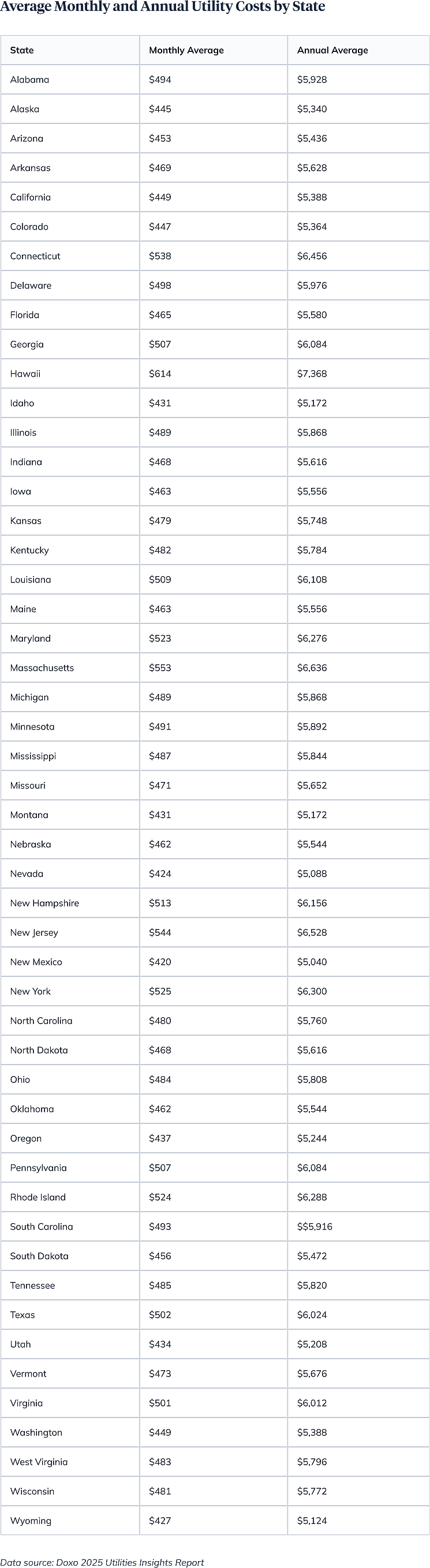
National averages mask significant regional differences. The doxo report put the national average monthly utility cost at $489, but state-level averages range from about $370 to more than $650 per month. Those differences reflect variation in climate, population density, infrastructure age and state-level energy policy.
The following figures reflect average combined utility costs by state, according to the doxo report.
Homeowners and prospective buyers can get a realistic estimate of utility costs using several methods:
A state's average utility price is a useful benchmark, but individual circumstances ultimately determine a household's cost profile.
Once homeowners understand their utility costs, comparing them to local averages can help identify problems or opportunities for savings.
Utility costs that run 20% or more above local averages, after accounting for these factors, are typically worth investigating further.
Homeowners whose utility bills exceed local norms have several options for reducing costs:
Reducing utility costs can lower a household's environmental footprint as well as its monthly expenses.
Utilities represent only one piece of the homeownership expense picture. Between mortgage payments, property taxes, insurance, maintenance, utilities and unexpected repairs, the total cost of owning a home often exceeds what many buyers initially budget for.
Understanding the full range of ongoing homeownership costs, not just utilities, is an important part of long-term financial planning for both prospective and current homeowners.
This story was produced by Hometap and reviewed and distributed by Stacker.